

October 2026
Vujinović & Partners


An AI Watermark Is Not Proof of Authorship: Where Does the Technical Signal End and the Legal Question Begin?
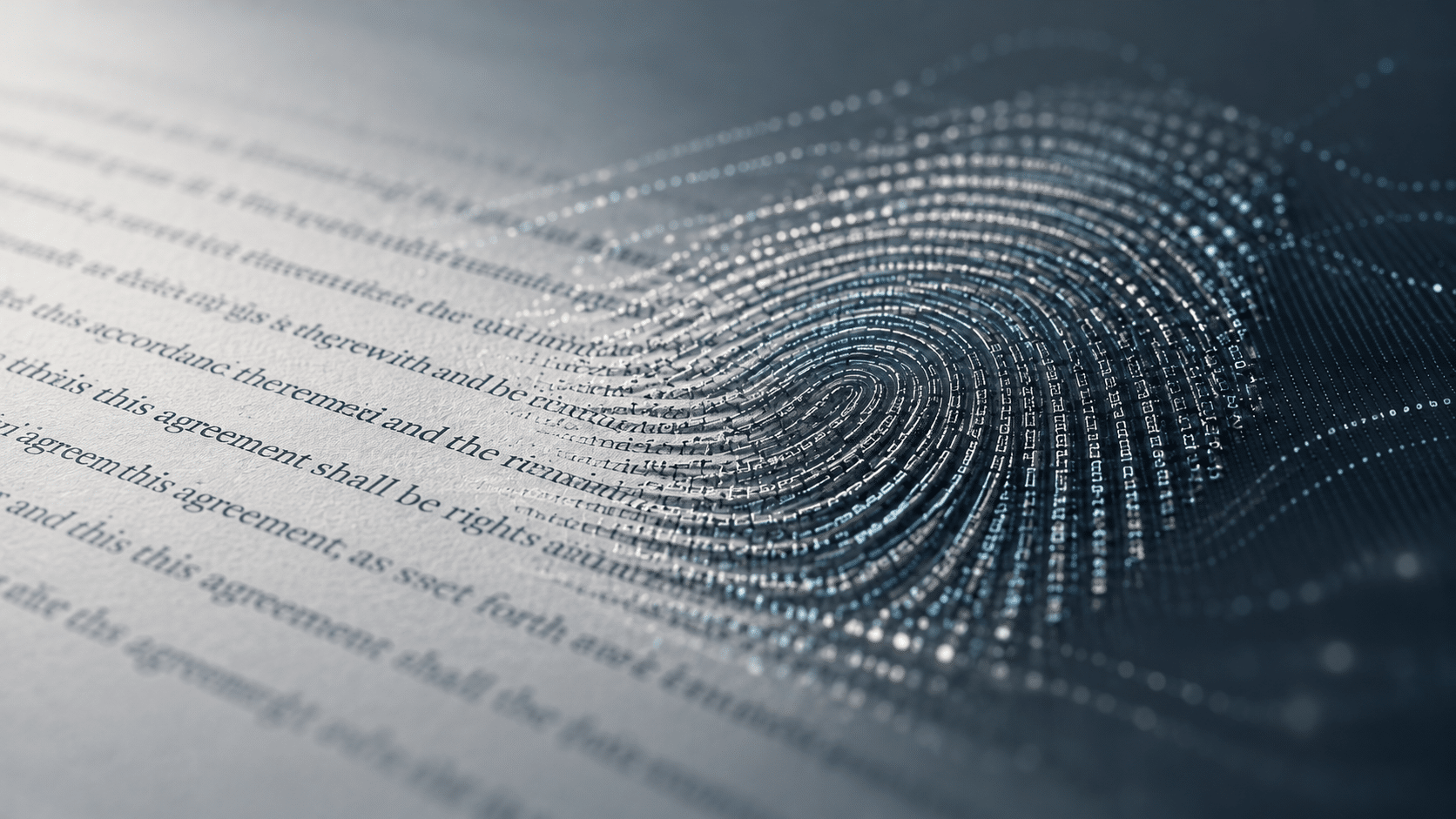
Anthropic’s introduction of an invisible watermark into text generated by its new Claude models has raised a question that extends beyond the technology itself: what legal significance can be attributed to a technical signal (watermark) indicating that an AI system was involved in the creation or processing of a particular text?
According to the explanation published by Anthropic, the watermark enables an assessment of the likelihood that Claude was involved in producing a text, while the underlying pattern remains invisible to the reader. However, the company also emphasises an important limitation: the watermark cannot establish whether Claude wrote the text or merely made substantial edits to it.
It is precisely this limitation that makes the technology particularly interesting from a copyright law perspective. A technical signal may indicate the involvement of an AI system in the process of creating content, but it does not reveal who made the creative decisions that shaped the final text.
Such mechanisms also have a broader regulatory context. The EU AI Act establishes certain obligations concerning the marking and detectability of AI-generated and AI-manipulated content. However, transparency regarding the use of AI systems should not be conflated with the question of authorship. The fact that AI involvement in the creation of content can be identified does not, in itself, determine who qualifies as its author or whether the resulting content meets the requirements for copyright protection in the first place.
AI Involvement Is Not the Same as Authorship
Consider a text originally written by a human and subsequently proofread or stylistically edited by Claude. Depending on the extent of the AI intervention, a watermark may be present, but its detection alone reveals neither who authored the original text nor the extent of the human creative contribution to the final version.
Anthropic notes that, where Claude is used to proofread human-written text, the watermark may be so limited that it cannot be reliably detected. In the case of translation, by contrast, the signal may be more pronounced because the AI system selects virtually every word.
Translation is, for precisely this reason, a more interesting example from a copyright law perspective. The fact that an AI system has translated a particular text does not affect authorship of the underlying original work, but it raises a separate question concerning the legal status of the translation itself. Where an AI system has made almost all the linguistic and expressive choices, it becomes necessary to consider whether the final result contains a sufficient degree of human creative contribution to qualify for copyright protection.
From a copyright law perspective, therefore, the mere fact that an AI system has been used is not decisive. The author is the natural person who created the work, while, under EU law, originality is linked to the author’s free and creative choices. The central question is thus not merely whether AI was used, but who made the creative decisions that gave the final work its particular form of expression.
The question “Was AI involved in the creation of this text?” is therefore not the same as “Who is the author of this text?” A watermark may be relevant to the former, but it does not, in itself, provide an answer to the latter.
What Evidential Value Can a Watermark Have?
Its legal relevance will depend primarily on what is at issue in the particular case.
Where it is necessary to establish whether certain content was processed using Claude at some stage, the detection of a watermark may constitute a relevant indication. Where, however, the dispute concerns who made the creative choices, who may claim copyright protection, or the extent to which the final result is a product of human creativity, a substantially broader evidential context will be required.
Such an analysis may encompass working drafts of the document, revision histories, instructions provided to the AI system, the manner in which generated content was selected, combined and modified, as well as the extent of subsequent human intervention. Technical information concerning the use of an AI system therefore cannot, in itself, substitute for a legal assessment of the process through which the particular work was created.
Moreover, the absence of a watermark does not necessarily mean that AI was not used. In shorter texts, the signal may be insufficient for reliable detection, while subsequent modifications may weaken or remove it. The reliability of such mechanisms is already the subject of broader academic and technical debate. In reporting on the introduction of Anthropic’s system, Nature also highlighted reservations expressed by some members of the research community regarding the possibility of reliably identifying AI-generated content on the basis of such technical markers.
From Technical Signal to Legal Conclusion
The development of watermarking technology does not, therefore, resolve the question of authorship. Rather, it introduces a new category of technical information that may be relevant when assessing the human creative contribution involved in the creation of a work.
As AI systems increasingly become part of the ordinary processes of writing, translating and editing, it will become ever more important to distinguish between two separate questions: whether an AI system was involved in producing particular content and who, as a matter of law, made the creative choices that shaped its final expression.
A watermark may assist in answering the first question. The second will continue to require a legal assessment of the specific process through which the work was created.
It is precisely here that the boundary lies between what technology can detect and what copyright law must establish.